Speaker 1:
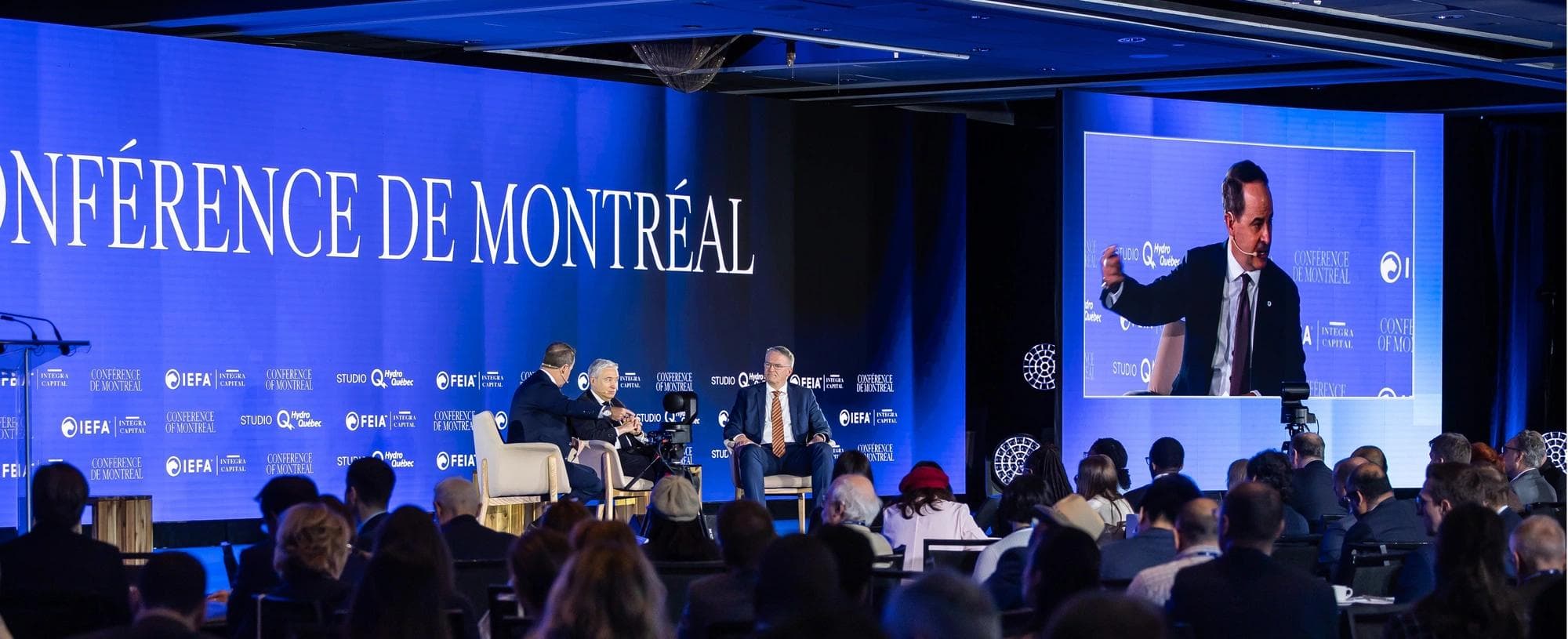
Today's episode comes to you from the Conference of Montreal, recorded on June 8th where global leaders gathered to discuss one of the most pressing topics shaping the economic landscape today, the new policy playbook. In this panel, BMO CEO, Darryl White, moderates a candid and forward-looking conversation on how governments and institutions are adapting to a rapidly evolving global environment. He's joined by Mathias Cormann, Secretary General of the OECD, and François-Philippe Champagne, Canada's Minister of Finance and National Revenue. Together, they explore how policy, growth, and competitiveness intersect and what it means for businesses and economies moving forward. Let's dive in.
Speaker 2:
Welcome to Markets Plus, where leading experts from across BMO discuss factors shaping the markets, economy, industry sectors, and much more. Visit bmocm.com/marketsplus for more episodes.
Darryl White:
It's a pleasure to be here in my case representing the bank of my hometown in my hometown. We have so much to cover. I can't emphasize enough how distinguished our guests are and I can't think of a more interesting time in terms of what's going on in the world. Confluence of three huge, and I mean huge events. We've got reorganizing geopolitics. We've got what might be jury's out, but probably is the greatest technological revolution, certainly in our lifetimes, maybe in the history of the world in the form of AI. And we got two hot wars going on in Europe and the Middle East and this is disrupting supply chains and affecting the way we do business and commerce as we speak and productivity.
Easy questions to get through for both of you. But maybe if I could start with you, Secretary General, from the perspective of the OECD, when you put these factors in the mix and we used to think about the competitiveness of nations around productivity and GDP gain, and now we've got to consider all of these factors in terms of the power of a nation driving its own productivity and outcomes for the world, where are we? What is your general view? And if you could, if I could nudge in a Canada question for you, how does Canada fit in to the world assessment from the OECD perspective as a middle power?
Mathias Cormann:
Well, I think it still is very much about productivity and indeed there's a very significant productivity growth challenge across OECD member economies and that is one of the things that we need to tackle more effectively. But if you look at the way the global economy is functioning, if you look at global rules-based trading arrangement, clearly open markets, rules-based trade has delivered significant growth, has delivered significant increases in incomes and living standards in countries around the world, including here in Canada as a successful open export-oriented economy. But the rules-based trading system is under pressure.
And that doesn't mean that we should throw the baby out with the bathwater. Open markets and rules-based trade remain very much important, but we also need to be quite clear eyed about some of the risks and challenges that have emerged in recent years and become more obvious in recent years, the capacity of the rules-based trading system to discipline unfair market distorting trade practices, for example, issues around fragile supply chains.
When we look at what will make economies internationally competitive and successful into the future, the digital transformation and AI very much at the core of it, advanced manufacturing, reliable access to critical minerals is incredibly important. And when you look at the explosion in demand for critical minerals and semiconductors that is coming our way and what is happening on the production and the supply side, which is not keeping up, where we see things like we see excessive concentration of supply in some small group of countries where we see growing levels of export restrictions.
There's a range of challenges to make sure that rules-based open markets and rules-based trade and that international trading arrangements can function better or fairer and can function better, but in a way that preserves the economic benefits of open markets and rules-based trade.
Now, what we say to countries around the world, what we say to member governments and countries around the world is work harder to resolve those issues, those genuine and legitimate issues through dialogue and cooperation, working with each other bilaterally and multilaterally, including through an organization like ours. Avoid doing it unilaterally because unilateral measures inevitably make things worse.
Now, just to go back to where does Canada fit in all of this, in the context of what's been happening over the last 18 months to international trading arrangements, tariff policies out of the United States, uncertainty in trade policy settings, obviously Canada is going through a big transformation, big transition of focusing on diversification of its trading arrangements. But Canada is an open export-oriented trading economy, which has shown remarkable resilience.
And when you look at the economic growth performance of Canada, we just recently released our global economic outlook and Canada has got the second strongest growth outlook across the G7 just behind the United States. So, I think Canada is looking at some of the challenges in front of us from a position of comparative strength and of course provides very important leadership when it comes to some of the conversations around how we can reform and strengthen international trading arrangements moving forward.
Darryl White:
Minister Champagne, having listened to what we just listened to, Canada is also in this hinge moment. You and the prime minister have talked about this a lot, transforming its economy through the hinge moment effectively caught between the US and China. We're not going to compete on out investing. How are we going to outcompete in that environment and what's the agenda?
François-Philippe Champagne:
Well, first of all, thank you, Darryl. I think what we're facing, the reality of the world, it's the speed, scope, and scale of change, which is quite unprecedented. As some people would say, you go back to 1945, fall of the Berlin Wall, but it's geoeconomics, it's geopolitics, it's supply chain, it's AI, it's quantum, it's cybersecurity, and that is bringing a sense of loss of control. And I would say the transmission between global events to national reality is very quick. We went from an energy crisis to an affordability challenge in pretty much all the OECD countries, certain in the G7, cost of rent, cost of food, cost of fuel.
Darryl White:
Very quickly.
François-Philippe Champagne:
Very quickly. And I think I'll come to your question very specifically because I'm often asked, "What is certainty in this world?" And I said, and Mathias is with us, we have the International Energy Agency number of colleagues with us at the number of meetings, but the nexus between food security, energy security, economic security and national security has never been greater.
And I think that's why forum like this one and the President Mathias is so important because in a world where when I presided the G7 of Finance Minister and Central Bank government in 2025, I said, "We cannot let uncertainty become the new certainty." Now, the world of 2026, I would say is a world of complexity and volatility where it's the unknown. It's the combination, a number of things.
So, what do you do in a world where everyone is craving for certainty? I would say, focus on what you can control. And that's exactly, to your point, Darryl, what have we done in Canada is to make sure that we have a growth agenda, that we do generational investments in order to grow the Canadian economy. The mother of all infrastructure plant in the G7 used to be the German plant, 500 billion euros, 12 years.
If you look at Canada in our last budget, $450 billion on a cash basis over five years. So, I would put to you that Canada today has the largest infrastructure plan of all the G7 nation. And in the world of both Kristalina, again, I think we were in Washington together, she said, "If countries which have the fiscal capacity..." And by the way, she mentioned two countries, not 25 countries. She mentioned Canada and Germany, two countries with triple A credit rating in the G7. "If you invest in infrastructure and housing, productivity, innovation, and defense, you will see growth."
So, the numbers that you have seen last week from the OECD I think demonstrate that Canada is on the right path. The Canadian economy and Darryl would know obviously as one of the largest bank in the country is probably more resilient than many people that expected because of the integration with the US economy, but no one is immune from the wind of change that you see in the world. Like I said, people in the street would feel that it's a loss of control and it's really windy.
And in that sense, we're not immune, but I would say in the context of the world we live in, focus on what you can control is probably the best remedy to make sure you have long-term growth and at the same time tackle affordability in the current days, because a lot of people are concerned about what's happening at the end of the month and the end of the week, which is the challenge not only in Canada, by the way, just look at the numbers out of the border in Europe.
The real challenge for all democracies and OECD country, I would say Mathias, the issue of affordability is front and center for all countries and that's what we need to tackle. So, affordability for the people now and at the same time having a strategy to grow the economy. And I would say trust is probably, and I'll finish really there, but trust is probably the word that Mathias would say that you heard the most at our meeting, who can you trust? And Canada obviously become the partner of choice in the world which is divided.
Darryl White:
It's a tool to force. If I pull us up to the balcony and maybe Secretary General, I could turn back to you, let's double click on technology, let's double click on AI and the pace of productivity and I know the OECD thinks about this and does a lot of work on this that is expected, how do we balance this in terms of what will determine the countries that will succeed and those who might not succeed including not just on productivity that you talked about earlier, but on this point about affordability and cost of living?
Mathias Cormann:
Well, when it comes to the technological innovation, when it comes to the digital transformation and AI, the most important thing in a way, it's not the innovation itself, but it's a level of diffusion and you need widespread diffusion and adoption. And at the moment when it comes to AI, the adoption is still quite concentrated both within countries and across countries.
And so, there's an issue there, of course, in terms of the infrastructure providing universal access, in terms of making sure that the skills piece is right so that us the labor market transforms that people have genuine opportunity to participate and benefit in the opportunities. And also, there's a piece around making sure that the policy and regulatory settings are right, that countries get the balance right. Because if it's too restrictive, it slows down the level of diffusion and that holds you back. But if it's too permissive, then obviously there's a risk that you lose public trust and that you expose yourself to systemic risks.
And these are the sorts of conversations at the OECD together with experts from around the world we're thinking about deeply. It was Canadian leadership during a previous G7 presidency that led to the establishment of the global partnership on AI and we're seeking to facilitate some of these conversations globally. Ideally, AI develops in a way that also is based on common standards and shared understandings at the global level.
But fundamentally, you need to look at AI and these sorts of technological innovations as general-purpose technologies, facilitating universal access, making sure that all of the things that are important like reliable and affordable access to energies, feeding datacenters and all of the infrastructure that underpins it facilitates widespread diffusion adoption.
I mean, the price is high. We do think that there is opportunity to boost productivity growth by up to 1.3% per annum, which might sound very little, but it compounds and the opportunity, the upside opportunity is unbelievably exciting. Beyond productivity, of course, across a broad range of services, improved healthcare, improved education across the whole ... The benefits, the potential benefits and the price for humanity is very high, but it will be important to ensure really that widespread diffusion and adoption beyond just the big large firms at the top.
Darryl White:
Do you want to come in on this before we go to another topic?
François-Philippe Champagne:
Well, I would say that's why Canada, as Mathias said, we were there to, and I was a minister of industry at the time, responsible AI because trust brings adoption and innovation, and without trust, that's the real challenge. You may have seen there was a piece in the EFT, I think over the weekend, talking about this trust element, which we all need to strive to really show the people how AI will be able to compliment what they're doing and augment in a way what they're doing.
And I think what was interesting, you may have seen because Darryl, you read all these things, but people are talking about physical AI now as the next frontier. We use AI now for queries, what's the best restaurant in Montreal? Where should I go if I have a bit of free time during the conference of Montreal? Which I'm sure you don't have, but physical AI is the next frontier.
Darryl White:
I'm going to keep going with you for just a minute here. On the Canada agenda for those who are our friends from out of town, out of country, there has been a lot of work done I think over the course of your, can I still say newish government, we're into 15 months now, if I'm counting right, on the notion of us being open for business attracting capital from around the world and domestically.
Can you give us a summary of where you think we are on that, including government sponsored capital like the Canada Strong Fund and how that plays a role in everything? And then I want to flip the question on the other side if you've got patience for two, a two-part question. I would argue it's great to have access to capital and I think we've done a good job getting people very interested in what's going on in our country, but you also need uses for that capital. Have we focused too much on sources and not enough on uses or are there enough opportunities that you could give a summary to folks here as to how we're thinking about developing the investment agenda in this country?
François-Philippe Champagne:
I love that. That's how we present our, when you prepare before the budget, it's called the sources and users. It's a very [inaudible 00:14:24]. I love that. Very few people have asked me sources and uses, but this is my bread and butter every morning as the source and uses for the government of Canada. I think I'll say a couple of things, but the first thing, the tone at the top matter, I think Prime Minister currently has inspired the nation and, in a way, also set the world agenda.
Everyone would have seen the Davos speech and I think he had the courage to say loud what a lot of people were thinking and people were talking in the corridor. I was in Davos that day. I was not in the room where he spoke, but I would say this Davos moment, there's always one Davos moment. And this was the Davos moment where I think he inspired the world to look beyond.
When I go back to the fog of uncertainty, I never talk about Canada as a country of 40 million people. What matters is your market access on a professional basis. Canada has professional market access to 1.5 billion consumers in the world. People sometimes would say demography is destiny. Well, you look at the countries where Canada as a free trade agreement born in Europe and in Asia, you would say, "We are in the fastest growing economy."
I would add that energy is destiny as well. And I think what you see at the big table, and I'll come to your question specifically is I think going back to my thing about the nexus between energy security and national security is that Canada is becoming the partner of choice. We were with Fatih Birol, which you would know th government are redesigning at a point where we're moving from reliance to resilience. And if you look at resilience, obviously Canada stands out.
Again, there was a great article recently that we're talking about the different straits in the world that would constrain logistics. And I keep saying the Straits of Hormuz will find a solution. Matias and I were at these meeting. But I keep saying geography doesn't change and people don't change that much either, so that will remain a choke point whether you're now in the future.
So, now you're looking at which country in the world, G7 and beyond even OECD. Well, Canada stands out. Why? Because we have vast abundance of conventional energy, LNG, oil and gas. We have a number of technology and I would say advantage in renewable energy. And we're one of the few countries in the world where you can certify nuclear energy.
So, I just want to say that in the world, which is looking for more certainty and predictability, Canada becomes a partner of choice because you're looking, you've been blessed by geography in terms of three oceans. You're next to the United States, never be an issue around security, and you have access to three ocean at a time where the world is craving for stability of energy.
And I always say, if you want to be at the big table, sell energy because energy is national security. You'll be invited to any table because you're going to be key and you've seen the Germans with fiber and you've seen our partners in Europe coming to us and obviously our partner in Asia. But I think that's what Canada, when we say we're going to be an energy superpower, this is not just a slogan. It's really a need in the world where the architecture is being redesigned.
Darryl White:
Secretary General, if I come back to you. As you listen to all this and as you think about all the inputs in all of the countries and the membership, if you could boil it down, ultimately, I think what we're all hoping for is more prosperity, more GDP growth per capita, more productivity per capita. What will define those who get that right relative to those who will struggle?
Mathias Cormann:
Well, I think the fundamentals actually are pretty consistent and have always been the same, open, dynamic, competitive markets. And when we look at the data, we've got a base called product market regulation indicators and we know that the countries with the 25% more business friendly product market regulation arrangements are substantially more productive than those with the least business friendly, market friendly.
So, open dynamic competitive markets, a good government with predictable rules and indeed providing certainty and stability in policy settings, skilled workforce, good infrastructure, and social cohesion, having trust and confidence of maintaining trust and confidence from your citizens and indeed global investors.
When you look across, it's essentially market based economic principles, democracy, rule of law, good government, that is the foundation on which you can then pursue sensible reform to ensure that you're positioned in the best possible way for the challenges and opportunities of your time. The world keeps evolving, the world keeps changing, but systems that are based on market-based economic principles and democracy are agile enough to be able to adjust and respond. And I think that is a sustained ingredient of success for countries like Canada.
Darryl White:
You both have an extraordinary perspective on flows of capital and flows of goods. Straits of Hormuz, what might you tell the audience in terms of your point of view on the implications as we look forward the next three months, six months, nine months on inflation of oil, also of agriculture products. And a lot of our clients are calling us, telling us they're a little bit worried about what the cost of the grocery store is going to be in the fall.
Mathias Cormann:
Well, look, the honest answer is it depends and we're going to obviously have to keep an eye on how it continues to evolve. We released our global economic outlook last week and we presented two scenarios. So, the punchline across the board is lower growth, higher inflation. The question is how much? And the question is, what are going to be the second-round effects?
Obviously, in terms of minimizing the impact on growth and inflation, the sooner this comes through a peaceful resolution, the sooner we can reopen the Straits of Hormuz, the better, the longer it lasts. Yes, there's the energy price shock, but the impact on growth, the negative impact on growth will become harsher and the impact on inflation, pushing up inflation is going to become more significant.
But what is probably not sufficiently well understood, yes, there's the impact on energy supplies and energy prices, but out of Gulf countries, there's actually also urea. A lot of chemicals get produced and exported out of that region, and urea, of course, that goes directly to food security, food affordability, food prices. A lot of the chemicals that are coming out of the Gulf region going to manufacturing process, there's obviously a risk over time of second round effects, it can start infecting the economy widely feed into wages and so on.
Central banks will be watching all of this. If it's contained, if it's a supply shock that's contained and comes to an end relatively soon, central banks will look through it, but the longer these lasts, the higher the risk of second round effects, the higher the risk that central banks will have to take steps in order to contain the inflation risk and make sure that inflation expectations remain anchored.
François-Philippe Champagne:
We've seen, for example, urea. So, that's fertilizers, which has then an impact on food security and we were talking maybe 50 million people. As a result of that, which is tremendous, would be forced into food and security in many countries of the world. Then you can think about helium and then you say, "Oh, how is that going to do? Because helium is essential to produce semiconductors."
So, what I worry, and Mathias was there, I think when we had this discussion at the G7+ is the secondary impact and the cumulative impact of the secondary impact together, which you need a very complex model in order to refine and understand the whole impact on so many different supply chains. And even when you talk to our colleagues in the Middle East, the destruction on productive assets will take years to resolve.
So, this is not an issue that is going away the moment we have a ceasefire or even peace. I would say what you're going to see over the next five, 10 years is a redesign of the energy architecture in the world, and therefore I think unlike you, Darryl, because you would not be [inaudible 00:22:35] a Canadian bank if you were not looking at the world full and saying, "Okay. Well, I see a lot of opportunities," if you're Canadian, because as Mathias said, "Stability, predictability, rule of opportunities, possibilities."
But at the same time, when you're looking at the state of the world today and what is phenomenal, I think, and the bankers and those who are doing trading in the room is the quick transmission. We're moving from an energy crisis to an affordability issue and how the transmission is quick on these things. And therefore, if you ask me what worries me, obviously the wind is blowing pretty hard everywhere and as much as in during COVID, no one is immune.
I repeat that to Canadian oftentimes is that we might have energy, we might try to produce more food, but we're not immune to what is happening in the world and we've felt it. Let's seize the moment, I would say, because I think we see opportunities and I would say let's be ambitious. And I think Matias with the OECD has been calling on countries to also have ambitious policies and together I think that we can make a real difference because no nation can be more confident that they're leaders and you are the leaders that people are looking into. So, back to you, my friend.
Darryl White:
So, there's a lot of wind out there, but we can build a better windscreen and seize the moment. Ladies and gentlemen, please join me in thanking not just for the time they spent today, but for a lifetime of public service.
François-Philippe Champagne:
Thank you very much.
Darryl White:
Thank you.
François-Philippe Champagne:
Thank you.
Speaker 2:
Thanks for listening. You can follow this podcast on Apple Podcasts, Spotify, or your favorite podcast app. For more episodes, visit bmocm.com/marketsplus.
Speaker 1:
The views expressed here are those of the participants and may not necessarily represent those of BMO Capital Markets, its affiliates or subsidiaries. For BMO disclosures, please visit bmocm.com/podcast/disclaimer.