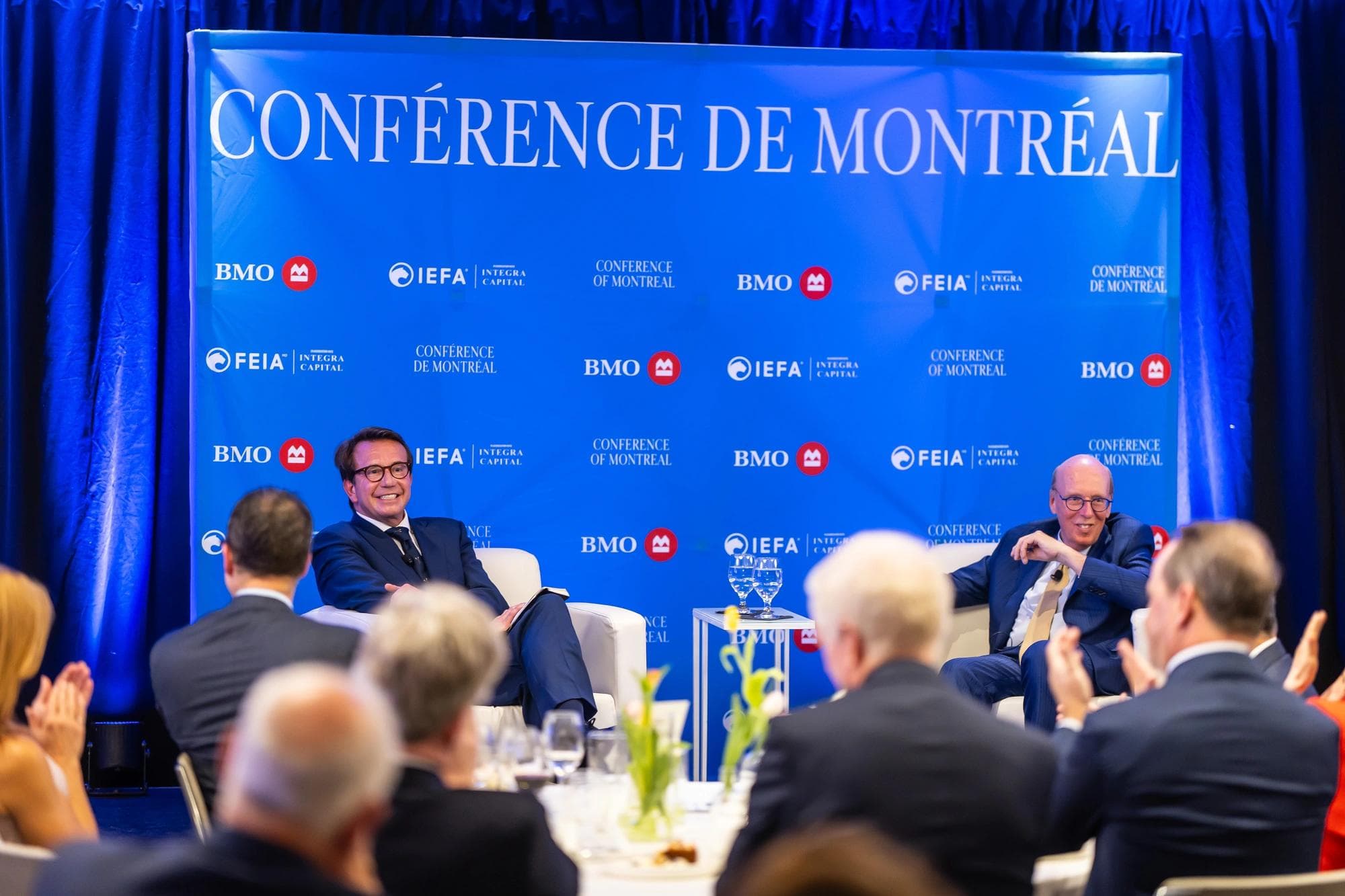
If you hit a rough patch in your career and question whether you can turn things around, think of Stephen Smith. Early on, he took a chance, failed, and then had the tenacity to try again. That second effort helped Smith become one of the most successful entrepreneurs in Canada, co-founding First National Financial in 1988, one of the country’s largest non-bank lenders.
Despite his remarkable story, Smith is just as likely to talk about his commitment to public service, which is every bit as notable as his business success. The son of a federal civil servant, he believes strong countries are built by people who dedicate themselves to institutions, whether in government, business, or civic life.
That belief has shaped much more than his business career. From his support of Queen’s University’s business school, which now bears his name, and Historica Canada, to his more recent acquisition of a minority stake in The Economist, Smith has consistently championed institutions that educate, inform, and enrich public life. Together, they reflect his belief that strong societies depend on strong institutions.
When Smith joined me at BMO’s Chairman’s Dinner, we discussed the experiences that shaped his remarkable career. His story offers a reminder that long-term success is often determined not only by ambition and opportunity, but by how entrepreneurs, investors and families respond to setbacks, manage risk and contribute to something larger than themselves. Here are the highlights of our discussion.
An early setback
Growing up in Ottawa, Smith said he developed a healthy respect for public institutions from his father, a career federal civil servant. His own interests, which were more mechanical in nature, would eventually lead him to Queen’s University to study engineering. By his third year, however, economics and business had become far more appealing.
Business had always interested him. As a teenager, he delivered newspapers and regularly discussed business ideas with his father. By the time he reached his third year at Queen’s, he had completed enough economics courses that he considered abandoning engineering altogether.
His father urged him to finish his degree first, seeing better job prospects in engineering than economics. Smith took his advice, then went to London for a master’s in economics at the London School of Economics. After returning to Canada, he decided to take the risk of building something of his own.
In 1982, he developed three houses in downtown Toronto. It couldn’t have come at a worse time. Interest rates quickly climbed to 20%, pushing carrying costs beyond what a small developer could absorb. “I entirely blew up,” he said. “I had to declare personal bankruptcy in 1984. I don’t recommend the experience to anyone. It totally destroys your confidence.”
Looking back, Smith acknowledges the experience wasn't solely the result of bad timing. He said he had taken on too much leverage and made decisions he would approach differently today – lessons that fundamentally changed the way he thought about risk.
The lessons of failure
Smith fell into a mini depression and had to find a way forward after the bankruptcy made him question many of his life decisions. But, eventually, he picked himself up and found work as a mortgage broker on Bay Street. “It was tough,” he said. “The way I dealt with it is you just get over it. You get a job and you rebuild your confidence.”
The experience also changed the way Smith approached making decisions. He realized that most people credit their own abilities when things go their way and blame bad luck when they don’t. He took a different view. “When you succeed, it’s good luck,” he said. “When you fail, it’s because of poor choices. That approach makes you a little more circumspect about your future decisions.” That mindset can be powerful, it keeps success from breeding complacency and makes failure a source of better judgment.
A strong second act
While working on Bay Street, Smith began to see an opportunity in the mortgage market. He was helping broker mortgages between financial institutions and realized there was room for a business connecting mortgage originators with institutions looking to buy those loans. In 1988, he partnered with a contact from Guaranty Trust to build First National.
The company started out small, with just six employees working out of a space above the Fox and Firkin pub on Eglinton Avenue in Toronto. It was hardly the setting most people would associate with what’s now a major financial services company, but back then, he was simply trying to prove the business model worked.
As the mortgage securitization market expanded through the 1990s and early 2000s, First National gained access to funding that allowed it to compete more effectively with Canada's largest banks. Combined with the disciplined approach to risk he developed after his bankruptcy, the company steadily grew into one of Canada's largest non-bank lenders, with more than $165 billion in mortgages under administration.
His financial success eventually led Queen’s University to rename its business school after him. Before the decision was finalized, he felt obligated to warn them about his past. “I said to the dean, ‘Look, before you proceed, I think there’s something about my background I should tell you about, because it might influence your decision.’ I said, ‘Well, I went bankrupt in 1984.’ He smiled and said, ‘So much the better.’”
Building legacy beyond business
In July 2025, First National was sold to a private equity firm in a $2.9 billion deal; Smith became a minority owner in the business. The transaction reflects a common inflection point for successful founders: how to balance liquidity, legacy and continued influence after building an enterprise over decades.
In April 2026, he embarked on a new business venture – co-owner of business magazine The Economist. He now owns 26.9% of the business, an investment he said reflects more than just a belief in independent journalism. A longtime reader of the publication, Smith said its commitment to open markets, democratic debate and strong institutions closely aligns with his own values. “But the real advantage of owning The Economist,” he said, “is that I get a free subscription now.”
For families, founders and investors, Smith’s story is ultimately about more than recovery from failure; it is about the discipline, humility and institutional mindset required to build and preserve wealth over time.