“But how do we know when irrational exuberance has unduly escalated asset values…”
– Alan Greenspan, Federal Reserve Board Chair, 1987 to 2006
The first half of 2026 was a tug of war between disruptive shocks and durable underlying trends. Markets were repeatedly tested by geopolitical tensions, policy uncertainty and an inflation scare. Throughout and despite this period of upheaval, the global economy remains resilient and adaptable – demonstrating yet again its capacity to deal with the blows. Faith in this resiliency under pressure allowed global stock markets to power ahead.
Growth has prevailed based on global fiscal largesse, durable consumer spending, and very strong corporate capital spending that is anchored in the artificial intelligence race but also supported by broader capex strength.
Looking at the back half of 2026 and beyond, everyone is wondering just how good things could potentially get if some of the problems were to go away. Solid advances in global equity markets and confident outlooks for very strong corporate earnings growth are screaming the answer: pretty darn good.
Middle East conflict
Conflict in the Middle East is the defining event of the first six months. The closure of the Strait of Hormuz and resulting supply disruptions sent convulsions through commodity markets.
At first glance, this presented a classic stagflationary risk: rising energy prices; higher inflation; and slowing growth. However, market reactions have been measured, with far less severe moves in asset prices than historical precedent might predict. The global economy is less energy intensive today, North America’s net energy-exporter position is acting as a buffer, and alternative supply channels, strategic reserves, and demand adjustments are helping to mitigate the impact. Even so, these mitigants have limits and some have expiry dates.
Feedback loops more powerful than ever
Capital markets continue to deliver important feedback to policymakers that helps ameliorate, if not resolve, the problems created.
In the first half of the year, this feedback prompted several notable course corrections. Rising borrowing costs for the Japanese government (tied to January’s election-driven fiscal expectations) led policymakers to walk back profligate spending plans. U.S. geopolitical developments in Venezuela and rhetoric directed at Greenland, along with further threats to the independence of the U.S. central bank, prompted a sharp selloff of the U.S. dollar and a parabolic rise in the price of gold.
By June’s G7 Summit there was no mention of Greenland. The appointment of Kevin Warsh as Fed Chair and his surprisingly less-dovish views quieted fears about the central bank’s independence. The result: a one-year high for the U.S. Dollar Index and a 25% decline for the price of gold.
Feedback loops go beyond the bond market
In the Middle East conflict, neither public opinion nor Congress was able to influence decision-making. Once again, capital markets forced combatants to negotiate.
We have described the bond market as the most important feedback loop because politicians must heed rising borrowing costs. Bond vigilantes aren’t the only ones on duty. Politicians’ second-worst nightmare is inflation – voters hate it and put the blame squarely on elected officials.
Rising oil prices provided two pieces of important feedback. The sharp move higher in spot prices delivered near-term pain to both sides: no revenue for Iran and inflation for America. These factors eventually drove the adversaries to the bargaining table. All the while, prices in oil futures markets stayed roughly in the US$70 range, signalling to investors that the spike in near-term oil prices would rise to whatever painful level was necessary to motivate negotiations. With tensions remaining high (but some oil flowing), this feedback loop could take time to deliver the intended result.
Private credit concerns surfaced but remained contained
Negative headlines in private credit facilities target only a subset of players; such episodes are not new to this asset class. It does not mean all private credit is bad. We do not believe it is widespread rot, nor is it causing contagion. Echoing what happened when regional banks like Silicon Valley and First Republic failed in 2023, shares of publicly traded private-credit asset managers are being broadly shunned until the dust settles.
AI and innovation – hyperscaled hyperbole
AI buildout is a positive driver of activity, but concerns remain around overinvestment, large initial public offerings, bond issuance, job displacement, and disruption of incumbent technology and software businesses.
The transition will bring challenges and opportunities, transforming some industries and jobs while creating new ones. Past technological innovations have featured this powerful and historically positive creative destruction – not apocalypse.
While exact outcomes remain uncertain, our research and conversations with experts suggest AI’s impact will likely be evolutionary rather than revolutionary. Many individuals are experimenting with or adopting AI, but widespread adoption by corporations requires a comfort level with issues of accuracy (hallucinations), legality, and privacy – just to name a few.
When hyperscalers are under the microscope because of their spending, that’s healthy and suggests investor discipline; it’s not the unbridled enthusiasm typically associated with a bubble.
Investors who maintain diversified portfolios and regularly take profits can navigate through and benefit from advances in these technologies.
Inflation and interest rates – between a cut and a hard place
Competing forces have shaped inflation trends in 2026. Heading into the year, inflation was on a moderating trajectory, supported by easing supply-chain pressures, softening labour markets, and contained wage growth. The Iran conflict temporarily disrupted this path, pushing headline inflation higher via escalating energy prices. The broader picture is more nuanced. Core components, particularly housing and wages, continue to exert downward pressure.
As the energy shock fades, fears are creeping in that the Goldilocks environment so beloved by stocks and bonds could swing too hot. One example of this: recent announcements of price increases on popular consumer electronic devices due to rising costs of memory chips.
Consequently, expectations for central bank actions have shifted. Rate cuts are no longer in the discussion. There is also a risk that central banks will be forced to raise rates if inflation rises because of all the positive economic activity. The same positive activity is powering equity markets higher. It’s the proverbial too much of a good thing.
Wait, did we have a recession?
Historically, we’ve seen that broad, upward revisions to global corporate earnings – unless they are tied to recession recovery or a productivity surge – usually point to some inflationary pressure ahead. Viewing them as wholly positive needs to be reconciled with this relationship.
We see a mix of factors driving earnings growth that helps to compartmentalize the situation. AI spending is one part, which brings some inflationary pressure. There is evidence of productivity gains, which can spread. Lastly, we think some of the earnings growth, especially given the broad-based nature across geographies and sectors, is a rebound from recession – or recession-like conditions in certain sectors or countries over the past several years. Think of areas like real estate, consumers’ selectively spending in response to inflation, manufacturing disruptions due to trade wars, and years of economic malaise in China.
The historical path of interest rates matters, too. Globally, policy was very restrictive until mid-to-late 2024. The effects of monetary easing since then are still coursing through the economy and taking time to play out.
Combining these arguments helps to frame the idea that expectations for sizeable earnings growth are neither a complete anomaly nor a siren-song that runaway inflation is nigh.
Will higher rates require a shift in expectations?
We see a risk that inflation will go from being fuelled by supply constraints to driven by excess demand. The good news is demand-induced inflation stems from too much of a good thing – namely spending, which drives earnings, which drives more spending, i.e., a virtuous cycle. In our view, stocks are the better place to be until there is more evidence of overheating and central banks potentially crashing the party.
In addition to the other deflationary factors we’ve mentioned, technological advances can bring their own deflationary offsets. The timing here may not be perfect and capital markets (and central bankers) may need to recalibrate repeatedly (think volatility) to adjust to incoming information.
For now, the expectation for rate cuts has been pushed out, and discussions of potential rate hikes have re-emerged. We see this being influenced by central banks’ desire to preserve (or repair) their credibility, still cognizant of the criticism they faced for their handling of 2022’s inflation spike. Importantly, we do not see the current inflation pressures anywhere near as severe as they were in 2022; similarly, markets are not currently anticipating a sustained tightening cycle. Capital markets may need to recalibrate (mildly, in our view) to incremental rate adjustments if conditions require them.
Our strategy – stay invested, stay diversified
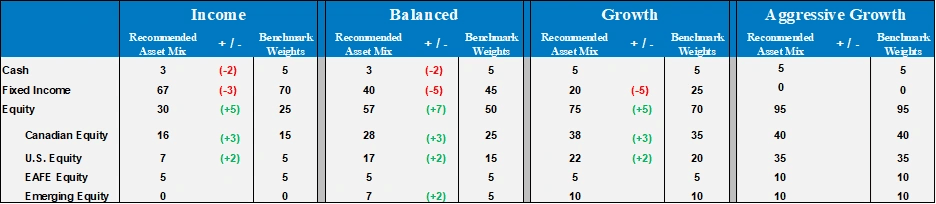
We continue to favour equities over fixed income, supported by strong and improving earnings growth globally, as well as the absence of a meaningful recession risk in the base case.
Within equities, we support an emphasis on diversification, both geographically and across market capitalizations. We believe it prudent to maintain an overweight to Canadian and U.S. equities, reflecting their exposure to commodities, innovation and strong corporate earnings. International developed and emerging markets remain important components that offer diversification benefits.
Investors may want to consider an increase in emerging market equities for portfolios where exposures are not already substantial, and the risk profile is appropriate. In our model framework, this is the balanced category.
Emerging markets offer exposure to a wide array of opportunities. This includes a growing number of companies participating in the AI theme in emerging markets ex-China. There is also a parallel ecosystem of AI innovation and buildout happening inside of China.
Investors taking exposure to emerging market equities should understand the volatility associated with this asset class. Periods of high return and outsized market corrections are the norm. We recommend calibrating position sizes accordingly (see Table 1).
Table 1: Asset Mix Recommendations, as of June 30, 2026
Updating our forecasts
We began 2026 with year-end price targets of 7,400 for the S&P 500 and 34,000 for the S&P/TSX Composite based on expected 2026 earnings growth of roughly 14% for both markets. Since then, expectations for full-year earnings growth have galloped ahead to 28% for the S&P/TSX and 25% for the S&P 500. The improved outlook has prompted us to raise our targets modestly while leaving room for earnings to grow into stock prices (valuations to moderate) and a repeat of the healthy sector rotation we have witnessed repeatedly in the bull market advance.
Our updated 2026 year-end targets are 7,800 for the S&P 500 and 36,800 for the S&P/TSX.
The last word: Exuberant, but not irrational
June 22, 2026, marked the passing of former Federal Reserve Chairman Alan Greenspan at age 100. The “maestro,” who chaired the Fed for more than 18 years, is credited with coining the term “irrational exuberance” in a December 1996 speech. It was interpreted as a warning the stock market might be overvalued.
For most of the 1990s, the S&P 500 had compounded at an above-average pace and posted calendar returns of 34% and 20% in the two years leading up to that speech. Mr. Greenspan’s warning was early – very early. The S&P 500 went on to advance 33%, 28%, and 21% over the next three years. In hindsight that was irrational exuberance.
Many people are drawing parallels between the 1990s and today. However, AI leaders are not the dotcom startups of 1999; they are real businesses with long legacies, massive revenues and diversified markets. They may be overspending to win the AI race; it may end badly for some. Still, that spending is real money flowing to other businesses and building tangible, much-needed infrastructure to address the wide global gap between supply and demand for energy and data centres.
If we are making comparisons, consider this: the 1990s brought nine consecutive positive years. Six of those years were above 20%, including five in a row to end the decade. Today’s bull market was born out of a 25% peak-to-trough decline in 2022 and has delivered three straight years above 20%. Going back 100 years, a calendar-year return above 20% for the S&P 500 is not unusual – it happened almost 40% of the time.
Our updated return forecasts represent a further mid-single-digit advance for the remainder of the year. That would bring both markets to a percentage return in the mid-teens for the calendar year. Exuberant, yes. Irrational, we don’t think so. We can only wonder if the maestro would agree.